As temperatures drop, colds and flu become more common. Shield yourself by nourishing your immune system with vitamin- and antioxidant-rich foods. Citrus fruits like oranges, lemons, and grapefruits provide a powerful dose of vitamin C, while leafy greens such as spinach and kale are loaded with vitamins A, C, and iron. Don’t overlook the immune-boosting properties of garlic and ginger; these antioxidant-packed ingredients can make a real difference. Add ginger to warm tea with honey and lemon for a soothing remedy that helps clear sinuses and ease a sore throat.
Keep Yourself Well-Hydrated
When the temperature drops, it’s easy to overlook the importance of hydration, but it’s just as crucial in winter as it is in summer. Warm beverages like herbal teas, lemon-infused water, broths, and soups are perfect for maintaining your fluid levels while also providing comforting warmth. Be sure to drink plenty of water, as dehydration can often be mistaken for hunger, leading to increased consumption during the colder months.
Boost Your Vitamin D Levels
With shorter days and less sunlight in winter, vitamin D levels often dip. This vitamin is vital for bone health and immune function. While food sources like fatty fish, fortified dairy, and eggs provide some vitamin D, getting outside in the midday sun for just 10-30 minutes can help meet your daily needs. Make it a habit to soak up some sun whenever possible. To learn more: https://www.sunsmart.org.nz/sunsmart-facts/vitamin-d/
Enjoy Seasonal Foods
Choosing seasonal fruits and vegetables is not only a wise choice for your health but also budget-friendly. These foods are more abundant, making them both affordable and accessible. They’re fresher, tastier, and packed with higher levels of vitamins, minerals, and antioxidants—perfect for boosting immunity and fighting off winter colds. By embracing seasonal produce, you’re nourishing your body while being resourceful. Curious about what’s in season? : https://www.produce.co.nz/seasonality-chart/
Winter doesn’t have to be a time of hibernation for your health. It is common for individuals to move less and eat more during the winter months as there are shorter days and less sunlight, causing people to stay inside. By incorporating these nourishing tips into your daily routine, you can embrace the season and enjoy the comfort and joy that winter brings, all while keeping your body well-nourished and active. Stay warm and stay healthy; summer bodies are built in winter!
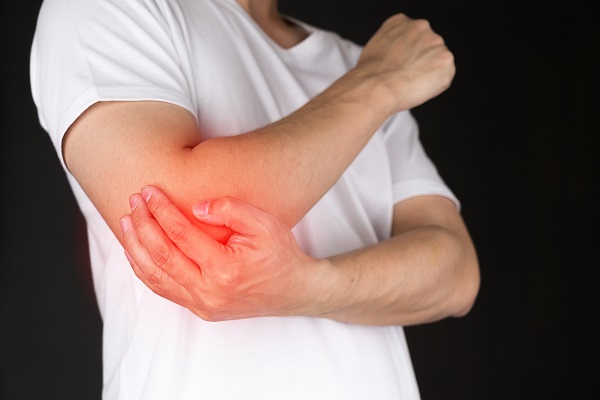
Tennis elbow, also known as lateral epicondylitis, is a common injury that affects the outer part of the elbow. Despite its name, tennis elbow is not just limited to tennis players, but can also occur in individuals who perform repetitive motions of the wrist and arm.
Causes of Tennis Elbow:
Tennis elbow is typically caused by overuse of the forearm muscles and tendons that attach to the lateral epicondyle (the bony bump on the outer part of the elbow). Repetitive activities that involve gripping and twisting of the wrist, such as tennis, golf, and manual labor, can put strain on these muscles and tendons, leading to microtears and inflammation.
In addition to overuse, other risk factors that may contribute to tennis elbow include age (individuals between the ages of 30 and 50 are at a higher risk), poor technique or equipment, and underlying medical conditions such as rheumatoid arthritis.
Treatment Options for Tennis Elbow:
The most effective treatment for tennis elbow involves a combination of rest, Physiotherapy and pain management. Some common treatment options include:
Rest and Activity Modification: Resting the affected arm and avoiding activities that aggravate the symptoms can help to reduce inflammation and promote healing. A period of rest is typically followed by a gradual return to activity with modified techniques.
Physiotherapy: A Physio can help to strengthen the muscles and tendons surrounding the elbow and improve range of motion. Specific exercises and stretches can also help to reduce pain and inflammation.
Pain Management: Over-the-counter pain medications, such as ibuprofen, can help to reduce pain and inflammation. In more severe cases, a physician may recommend a corticosteroid injection to reduce inflammation.
Bracing: Wearing a brace or splint can help to support the affected arm and reduce stress on the affected tendons and muscles.
Surgery: In rare cases, surgery may be necessary to repair the damaged tendons and muscles. However, surgery is typically only considered after conservative treatment options have failed.
Patellofemoral Pain (PFP) also referred to as runners’ knee often occurs as an insidious onset of pain felt around the patellar in the knees. With PFP having a sudden onset it can be quite an unusual yet sharp pain many individuals can experience that can cause high amounts of pain which can negatively impact that individuals’ training and even general activities of daily living.
Signs you have patellofemoral pain:
Anterior knee pain (pain in the front of the knee)
Increased pain when performing activities such as ascending stairs, walking uphill, squatting, prolonged sitting, or other activities that load the PFJ in a flexed position.
What is the cause of this pain?
Patellofemoral pain can be due to overuse injuries, biomechanical/anatomical abnormalities (e.g. patellar orientation/alignment), muscular imbalances/dysfunction (e.g. weak quadriceps) which can cause anterior (front) knee pain.
What can you do to improve pain?
Hip-strengthening exercises are preferred due to the decrease in perceived pain.
Orthotics to correct foot and leg posture.
Strengthening weak muscles to restore good function.
Running technique analysis.
A brace to stabilize the knee cap.
Surgery may be considered if non-surgical options do not improve the condition.
References:
Willy, R. W., Hoglund., L. T., Barton, C. J., Bolgla, L. A., Scalzitti, D. A., Logerstedt, D. S., Lynch, A. D., Snyder-Mackler, L., & McDonough, C.M. (2019). Patellofemoral pain: Clinical practice guidelines linked to the International Classification of Functioning, Disability, and Health from the Academy of Orthopedic Physical Therapy of the American Physical Therapy Association. Journal of Orthopedic & Sports Physical Therapy, 49(9), 1-95. doi:10.2519/jospt.2019.0302
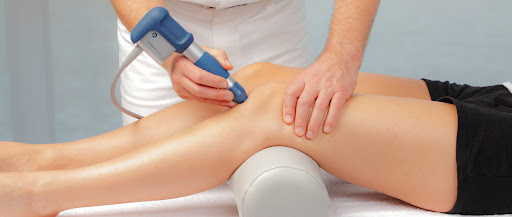
Shockwave Therapy uses a series of ultrasound shockwaves to increase blood flow, stimulate muscle repair and regeneration to promote healing in damaged tissues and can be an effective treatment for:
-Achilles tendinopathy.
-Gluteal and hamstring tendinopathy and pain.
-Patella tendinopathy.
-Plantar fasciitis.
-Osteoarthritis in the knee.
-Tennis and golfers elbow.
Quick
Treatments take around 3-5 minutes.
Non-Invasive
Does not require anesthesia, injections, or surgery.
Effective
Fast effective pain relief for common tendon injuries. May help reduce pain in soft tissue injuries. In some cases more effective than 3 months of traditional rehab.
How Shockwave Therapy works
-The shockwave works by delivering impulses of energy to specific damaged tissue via a compressed air impulse exerted by the handpiece.
-The Shockwave increases blood flow within the affected area, stimulating cell regeneration and healing and decreasing pain.
-Each treatment takes approximately 3-5 minutes to be delivered.
-Usually no more than 3 sessions are needed one week apart. Some patients note an immediate improvement in their pain however the best results occur 12 weeks after initial treatment.
How do I arrange Shockwave
Book today with any one of our clinicians from the booking menu. To discuss any precautions and warnings feel free to phone in advance on 09 379 5767 or email your questions to grafton@instituteofsport.co.nz
Existing patients
Ask one of our clinicians if we think Shockwave could assist in your recovery.
New patients and referrals
We accept referrals from other clinicians like your GP, orthopedic surgeon, podiatrist, or rheumatologist. Ask them to make the referral and book in with us.
We are all feeling stiff, sluggish, and mentally drained. 100+ days of Lockdown have been tough. Freedom Day Dec 3 signals lesser restrictions as the greater Auckland region opens up. The Institute of Sports ethos is the healing power of Movement & Activity that’s what we believe and we are here to help you get there whether it’s beach cricket, Bowls at the club, twilight Tennis, that summer body on lock at the Gym or mucking in the Garden. We are here to remove the bodily pain that 100+ days of limited movement has wrecked on us all and restore you to full function to kickstart an active lifestyle and significantly improve our mental health and well-being in time for Summer, Christmas, and the New Year so you can truly celebrate Freedom.
In that spirit to get you started please request via grafton@instituteofsport.co.nz your “ Freedom Home Exercise Programme” and Freedom Day Post Workout Stretches” that contains video demonstrations and detailed instructions on how to complete each exercise. You can view this program on desktop or in a mobile app.
“Freedom Home Exercise Programme” 20-30 min AMRAP (As many rounds as possible)
5 min warm-up (feel free to combine the following):
Lite walk around the street or Fast Walking
Marching on the spot
Knee raises on the spot
windmills
“Freedom Workout”
Squats x 10 repetitions
Push-ups (or kneeling press-up) x 10 repetitions
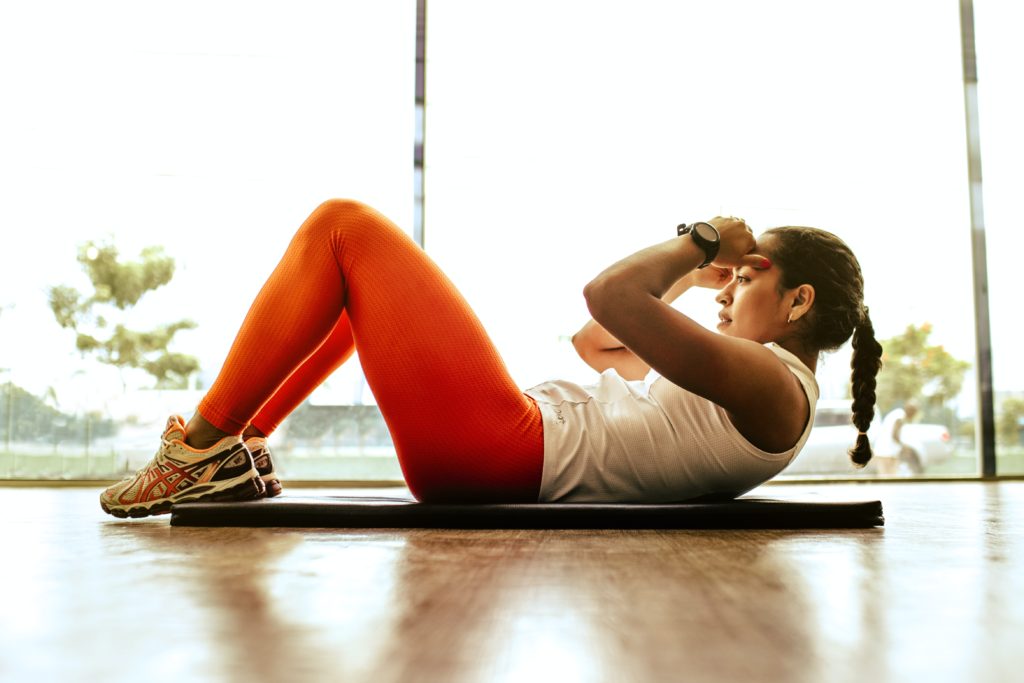
Sit-ups x10 repetitions
Standard Plank (hold to the count of 10 seconds)
Kettle Bell Swing x10 repetitions*
Supine bridge and hold to the count of 5 seconds x 10 repetitions
Prone Chest lift x 10 repetitions
Alternating Shoulder Press each arm x 10 repetitions*
Warm-down stretching
Standing Hamstring Stretch on chair (hold to the count of 10 seconds)
Seated Gluteal Stretch (hold to the count of 10 seconds)
Gastroc Stretch on Wall (hold to the count of 10 seconds)
Soleus Stretch on Wall (hold to the count of 10 seconds)
Standing Shoulder Posterior Capsule Stretch (hold to the count of 10 seconds)
Standing “L” Stretch at Counter (hold to the count of 10 seconds)
Standing Quadricep’s Stretch (hold to the count of 10 seconds)
Standing Pec Stretch at Wall (hold to the count of 10 seconds)
Latissimus Dorsi Stretch at Wall (hold to the count of 10 seconds)
Single Knee to Chest Stretch (hold to the count of 10 seconds)
Prone on Elbows Stretch (hold to the count of 10 seconds)
Kneeling Thoracic Extension Stretch (hold to the count of 10 seconds)
*If you don’t own a set of dumbbells, kettlebells, or Swiss Ball you can email us @ grafton@instituteofsport.co.nz or phone 093795767 to advise and arrange purchase.
To take full advantage of our expertise please email us @ grafton@instituteofsport.co.nz or phone 093795767 to arrange a consultation with our Physio Aaron Scott.
We at the Institute of Sport Physiotherapy are extremely proud to announce our sponsorship of the very talented professional squash player Elijah Thomas as he pursues his goal to represent New Zealand at the 2022 commonwealth Games.
Elijah a former Auckland Grammar student in 2019 left after year 12 to study a Bachelor of Sport and Recreation part-time at AUT before deciding to go all-in and focus full-time on a professional squash career and why not with a resume that has seen him achieve 5x NZ age group squash champion, Oceania u17 champion 2019, Australian Junior Open champion, 2019 World Squash Federation World u17 boys ranking #2 and 2x New Zealand junior team representative at World Junior Championships 2018, 2019.
Having won the squash Auckland Junior sportsman of the year two years back-to-back in 2019 and 2020 and holding the #1 u19 NZ junior ranking Elijah is truly a young and promising star on the rise and we truly delighted to assist.
To follow Elijah on his journey be sure to check in on him on both Instagram & Facebook @elijahthomassquash
The Institute of Sport Physiotherapy’s ethos “We believe in the power of movement and activity, let’s get you there” inspired this blog series. I intend to place an individual whether it be an experienced Surfer or novice Free-Style Dancer alongside myself as participant/fly-on the-wall with you the reader front and centre of a Movement and/or Activity-Based practice. Upon completion an interview shall reveal what drives our unlikely hero in their favoured pursuit? and ultimately what power & emotion surfaces simply in the act of doing.
let’s ease
then into our series with a light stroll led by Shiatsu Massage Therapist/Model
Himi Horikoshi; its Wednesday 15th January 2020 we are about to meet
in Cornwall Park “a lush landscape gifted by Sir John Logan Campbell to New
Zealand in 1901” under blistering “Tiffany Blue” skies at precisely 1:54pm.
But before
we do…
Its 12:33pm and and via facebook Messenger Himi has kindly suggested we meet at the Cornwall Park Rotunda @ 2:00pm. The message includes a thoughtful link with map & simplistic legend of the park included. I pull into the carpark adjacent to Twin Oaks Drive at 1:46pm. Phone at the ready we calibrate our positions with a series of photo’s sent back & forth a light game of cat & mouse. It is here at 1:54pm that we begin Himi the victor is the first to pounce grinning ear to ear attired in active wear, sunglasses and cap and the most infectious kind of got-ya-grin. In contrast I’m jumpy, sweltering and weighed heavy in lumpy cross train shoes perfect for tricky surfaces and the elevation to the 182-meter giddy peak of One Tree Hill. I’m overly hydrated with a sweet heady mix of liquid BCAA’s (Branch chain Ammino Acids) that will keep me well nourished under the most demanding conditions. At that we fall into an easy stroll under no harsh or demanding conditions what so ever. Himi the guide.
over here
The weather
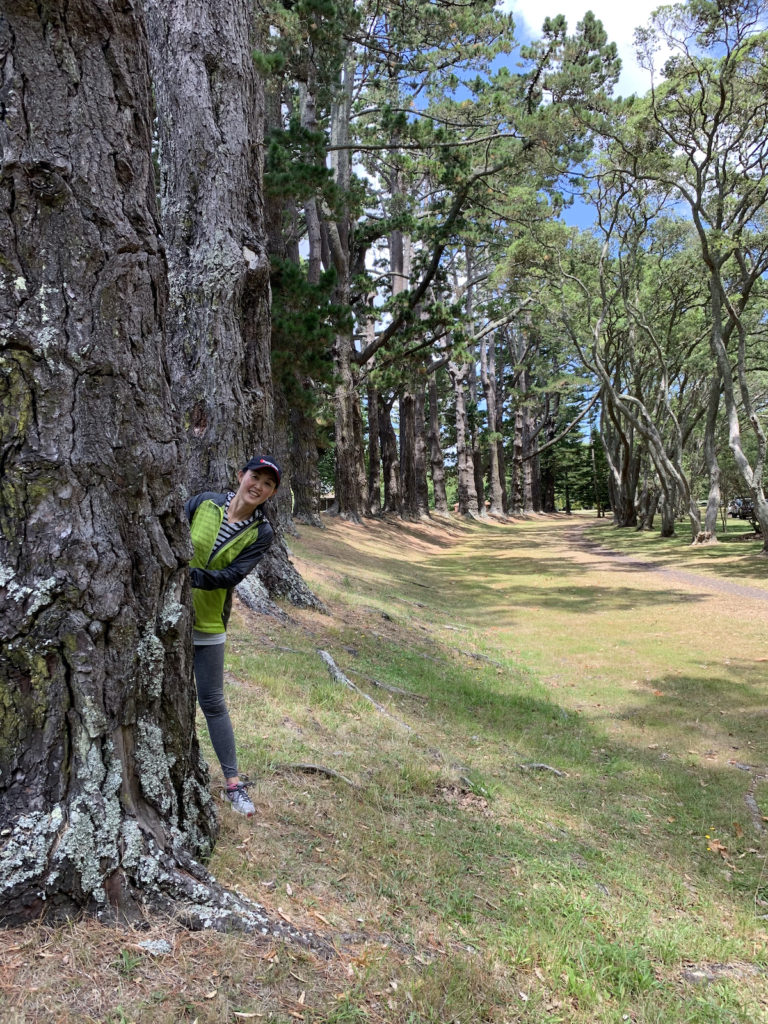
a snug 23 degrees Himi expertly suggests a pleasing route under the shade of
the Coast Redwood and Horse Chestnut trees near the Bistro carpark. A photo
from her capture’s me unaware, a wise move as one’s wits should surely be at
the ready, I remind myself.
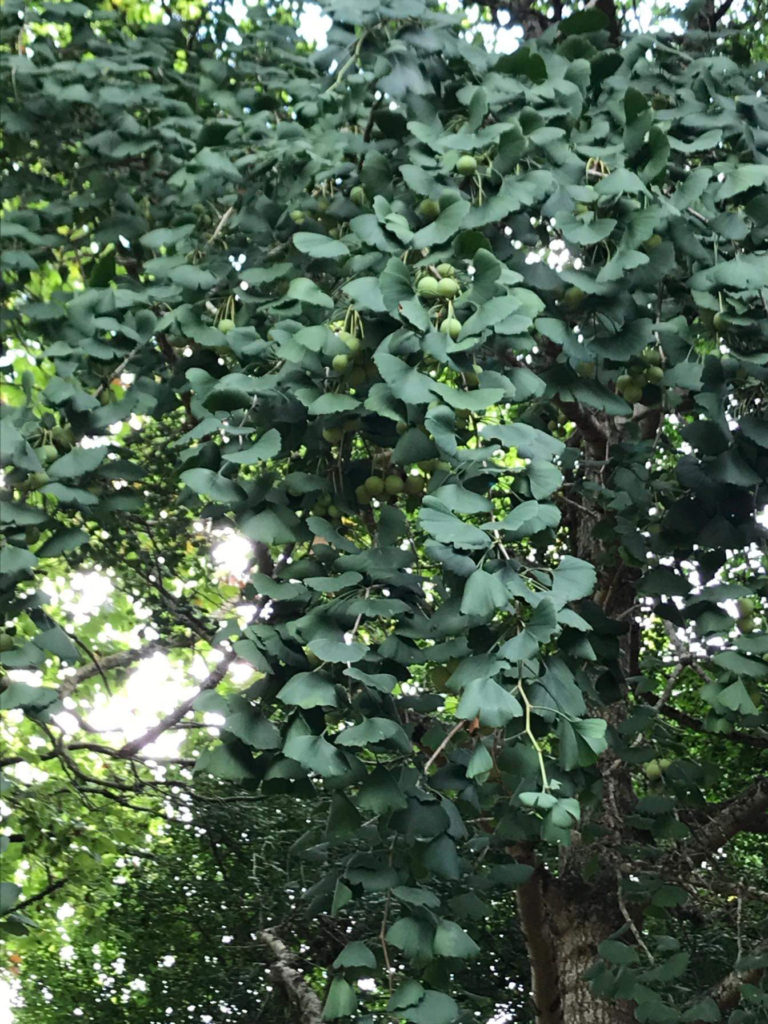
The photo incident well behind us now we venture towards “the much-admired” group of Gingko Trees found between Pohutukawa Drive and the Park Café the strong aroma of freshly laid fertilizer holds us at a short distance where we expertly speculate on the benefits of the leaf’s extract’s and so on.
“much admired” Gingko Tree
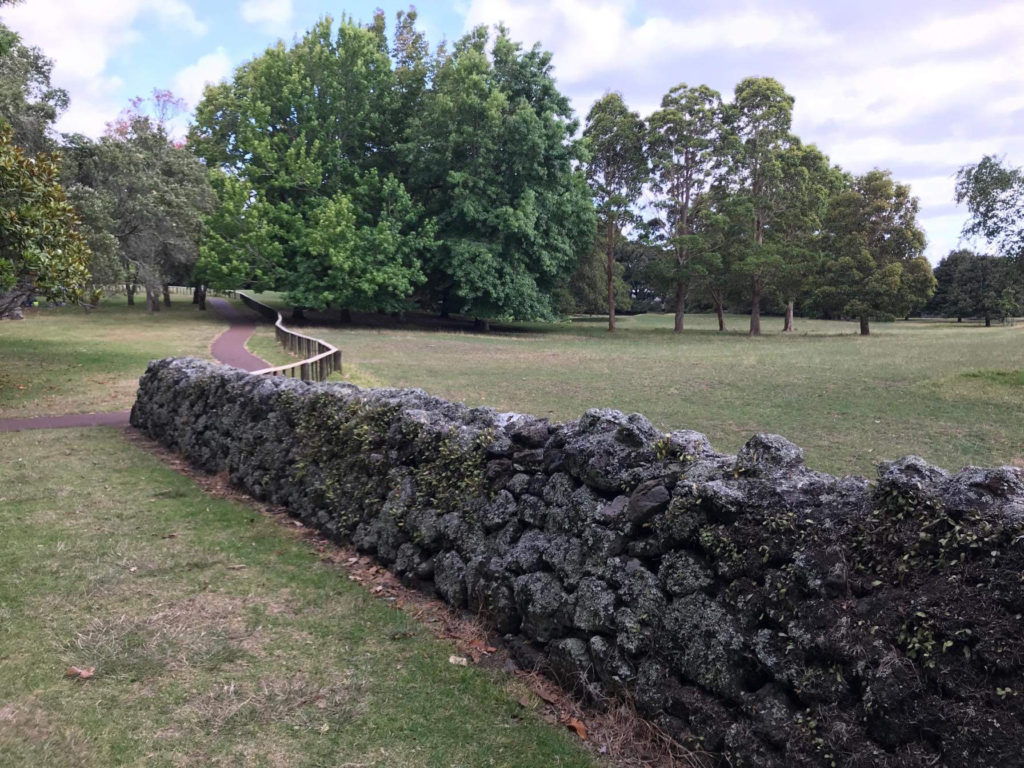
Satisfied our knowledge of this species is complete our sights fix upon one of the many stone walls scattered throughout the park that offer comforting distraction and recreation to lean and ruminate against. Himi eloquently pontificates to my benefit that the park though very natural is man-made, its care and overall harmony depends on the array of park custodian. Cheers to that I say well said.
Stone Wall
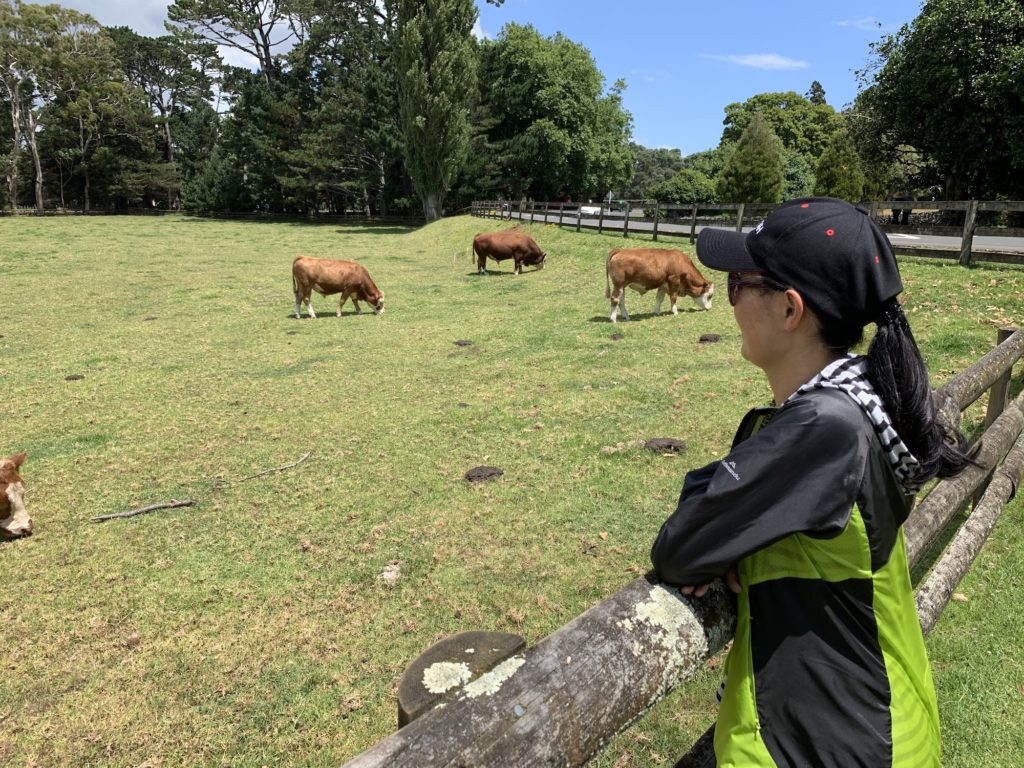
Our curiosity barely quenched Himi navigates a short slight-of-hand detour that brings us under the soaring Oaks that line Twin Oaks Drive. We fall into a majestic saunter “The Farm” home to 600 sheep, 60 cows and 2 full time farmers our stage. The south east “Farm gate” lean-to the perfect vantage to catch the cows at peak feeding and judge best-in-show.
Best in show
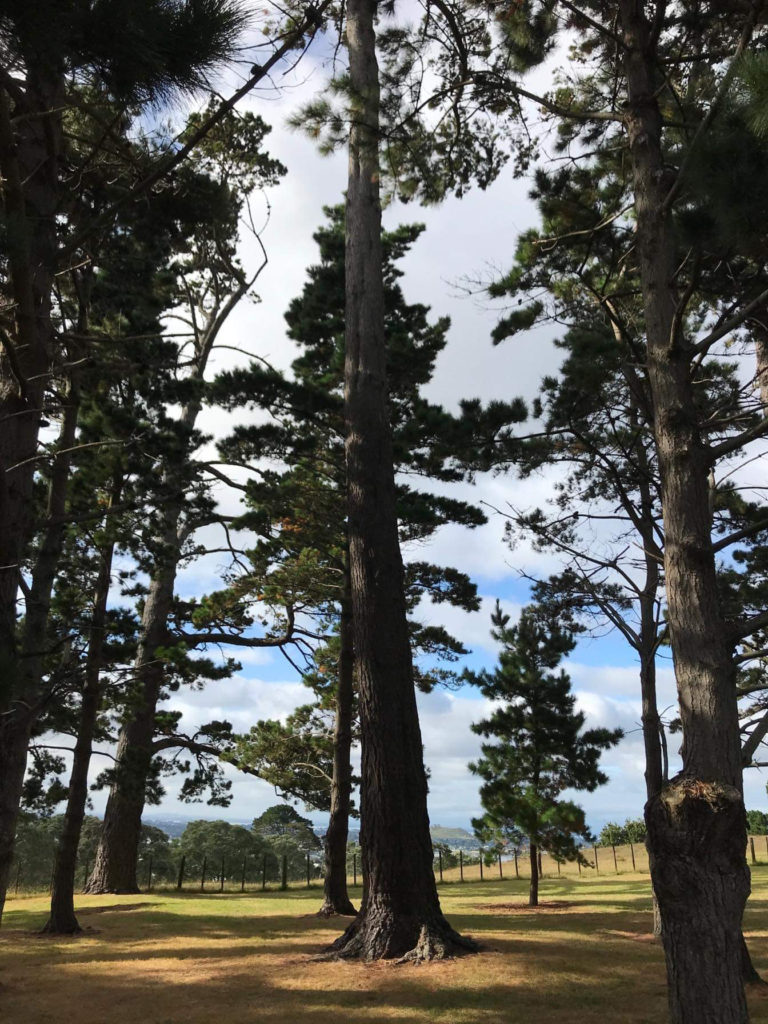
Show over and cows retiring to slumber Himi gestures to an area of the park at the most south western end and adjacent to the Auckland Archery Club that offers a splendid view across New Zealand’s second largest harbour the mighty Manukau an area that features a remarkable symmetry of pine’s in which to admire, rest or reorientate ones route. In our instance an improvised pine cone gathering amusement serves sufficient distraction.
Pines
It was here pinecone at the ready I put to Himi a number of questions in relation to “The power of movement and activity”.
Q: Himi what movement or activity-based pursuit do you most enjoy?
A: I do love Walking. Though I prefer the term Strolling as opposed to
say Powerwalking. Strolling allows me to relax “smell the flowers” so to speak
and take my time. I don’t feel the need to go the same way all the time so in
that sense I love the freedom of Strolling.
Q: Do you walk every day?
A: Almost, even rainy days. I like to think on rainy mornings that “I’m not like sugar I and I won’t melt”. I like the variety of people attracted to the outdoors in the rain you are amongst some very passionate Walkers, Runners and a variety of people training.
Q: Do you take photo’s when you come out?
A: Yes
Q: Do you like to share the photo’s with people?
A: Yes though for close friends or family and
simply creating and saving memories for myself. I do notice when revisiting the
photo’s that I have taken in the exact same walking location that the passage
of time and weather has a way of creating a different place In that sense I
feel a part of nature.
Q: What emotions do you feel while strolling?
A: A “gentle warm soup” best describes though I
feel an overall tranquillity. I can see very clearly and my senses are strong.
Q: Do you listen to music while you stroll?
A: Sometimes. If I do listen to music, I prefer Ambient music. I don’t
like to wear headphones so I will play music from my phone at a small volume in
my pocket while I walk. I feel its less enveloping and I still feel engaged
with my surroundings.
Q: What is your favorite movie/ book or piece of popular culture that features walking?
A: Wow a movie about walking! I did read a book “Norwegian Wood” they walk a lot.
Q: Any thing else you would like to add that may help readers?
A: I do recommend Strolling locally. I feel when we drive we miss so many details that only a stroll can offer like the many picturesque views and beautiful gardens. I can only suggest to Start slowly. Both nature and people offer up such beautiful things.
Did you know that what
and when you eat can massively impact your injury prevention and recovery time?
Is the way you eat now leading you to a path
of prolonged or higher risk of injury?
Have a read of this…
… You’ve done your back in…. or maybe you pulled a shoulder
muscle.. or maybe you have a troublesome knee..
It
can feel like a major setback right?
Are you suffering an injury that has you feeling frustrated, fed
up and unmotivated?
For 3
years I suffered major muscle spasm in my lower back… I couldn’t exercise, I
was a misery.. mostly caused by a weak core.. but also exacerbated by not
eating right ( even when I thought I was eating right! ), too much acidity in
my body, dehydrated.. the pain was constant and travelled down my glutes,
hamstrings and it aged me.. boy did I wear the pain on my face, it was apparent
in my moods and my sleep was just awful.
I actually was worried I’d never run or be able to exercise like I used to ever
again?
Any of this sound familiar?
I was tired of feeling injured… so I spent a fortune on the
wrong treatments.. I wanted a quick fix. But with help from my physio I got to
work on the right exercises and stretches to help mobilise and strengthen the
area.. it took consistent effort and commitment to see and feel an
improvement..
.. and I totally overhauled my diet. I was back on my feet and
running again after 4 weeks of getting the body back to a balanced nourished
state. It’s been 4 years now, I’m now 41.. and I feel stronger than I did in my
20’s.. and I absolutely attribute this to nutrients.
Would you like to speed up your recovery and reduce the chance
of it ever happening again?
When it comes to recovering from a sports injury, many elements
come into play.
While not all of them are under your influence, one factor you
can control is the nutrients you provide your body.
Consuming the anti-inflammatory foods and supplements mentioned
below in is one way you can speed up your recovery.
It’s what and when you eat!
Consider your blood type, consider nutrient timing… consider
eating foods and supplements you to help recover from an injury more quickly…
Like..
Protein-Rich Foods. …
Fiber-Rich Foods. …
Fruits and Vegetables Rich in Vitamin C. …
Omega-3 Fatty Acids. …
Zinc-Rich Foods. …
Vitamin D and Calcium-Rich Foods. …
Creatine. …
Glucosamine…
Not sure how to go about it?
Are you ready to get your body back?
I’m ready
for you ??
* Hi my name is Pieta enquire with me now @ Sweat. Nourish. Love if you’d like to explore the best nutrition to suit your needs – happy to help!
Simply another great opportunity to connect, move & be active in a friendly, alcohol free social setting. Just so good for your soul and just the best workout ever. Join DJ Anirvan Deva, Wilhemeena Isabella Monroe, myself and the Tribe for fitness with a deeper meaning….were going to have a lot of fun on this one.
So it was, a seemingly random web surf that hurtled me into one the most influential people in Health & Fitness Kelly Starrett. This video sent me down the K-Star rabbit hole to his New York Times best-selling book “Becoming A Supple Leopard”, TRS website (The Ready State) and ultimately his online Movement & Mobility 101 course. Incredibly personable and a gifted teacher just had to share.